
Review: The Big Bad Brutal Biz
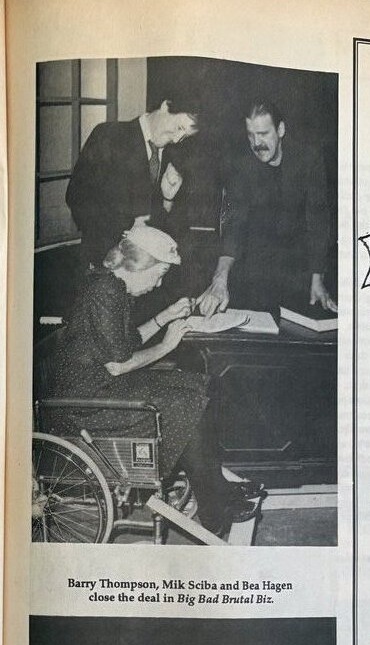
Barry Thompson, Mik Sciba and Bea Hagen close the deal in Big Bad Brutal Biz.
American Renegade Theater Company, 11305 Magnolia Boulevard, NoHo Arts District, (818) 763-4430
by Jim Berg
Living and working in the shadow of “The Big Bad Brutal Business,” the Los Angeles theatre community is constantly looking over its shoulder, checking the ominous presence of Hollywood. Whether it’s an actor looking for that big break or a director trying to get a foot in the door, the temptation is always to jump ship on opening night when the big break arrives. Obviously, live theatre will poke at big brother, as Fred Murray has done with “The Big Bad Brutal Biz” playing at the American Renegade.
“Biz” is a farcical depiction of a Hollywood bidding war that pits Mick O’File (Mik Scriba) of the Creative International Agency (CIA) against Seymour Lipschitz (Ed Smiley) of Colossal Studios and Jed Sligowski (R.J. Bondo) of Empire Pictures. All parties involved use any means possible—including shamus Nick Scagnetti (Danny Hicks)—to get the inside information on who’s making what deal. The object of all the deal-making and dirty tricks is the film rights to the autobiography of one Harlot. In addition to the shenanigans surrounding the bidding war, several subplots are woven in, featuring nepotism, affairs, ambition, back-biting and general skullduggery.
Putting on such a play in the shadow of Hollywood is a mixed blessing. The referential nature of satire can sometimes create backlash. For example, while Mik Scriba does fine playing what amounts to a big Irish thug, it is difficult to believe his character as an obvious parody of the Gordon Gekko type from “Wall Street.” And though Ovitz has at times been accused of thuggery, he is hardly a thug in either demeanor or style.
The play does have a good performance from the fast-talking, fast-thinking hustler/studio exec Jed Sligowski, who sets the pace for the entire second act. Unfortunately, as is the fate of every studio exec, he is fired. At this point the play and the storyline sag. Part of it is that there are too many characters and too many subplots in the script. The writer and actors are forced to resort to caricature in order to establish character and story, resulting in some confusion and a shallow experience.
While so many characters and stories diffuse the experience of the play, credit goes to R.J. Bondo and the production team for managing to pull it all off. I counted six different locations portrayed on the stage with hardly any set change. ♦